.svg)
For children, daycare centers are a jumpstart to healthy growth and development. For you, they could be the key to financial freedom and a rewarding career.
If you’ve ever wondered how to start a daycare, you’ll find that it requires careful planning and preparation. From choosing the right location to navigating licensing, insurance, and operating costs, there are several important factors to consider. This ultimate guide walks you through everything you need to know about opening a daycare center, including nine essential steps to launch your business with confidence.
Daycare centers in today's economy (2025 update)
The daycare industry remains vital, but it’s navigating one of its most volatile periods in recent memory.
Pandemic disruptions and ongoing struggles
Although the most severe COVID-19 restrictions have lifted, the sector is still grappling with fallout from the pandemic. During the height of the crisis, an estimated 16,000 childcare providers shut down, reducing the number of available centers by nearly 9% nationwide.
Since then, the expiration of pandemic-era funding—like the American Rescue Plan stabilization grants—has further destabilized the industry. Many centers, especially in underserved regions, are now at heightened risk of closure.
Skyrocketing costs and inflation pressures
Inflation continues to squeeze daycare operators. Providers face sharply escalating expenses for rent, insurance, staff wages, food, and supplies—fueling a precarious balance between sustainability and affordability. As a result, some are forced to raise tuition, which can drive away families already stretched thin.
Families bear the burden
In 2024, the average cost of center-based childcare for one child hit $13,128 per year, up 29% since 2020, overtaking the inflation rate for everyday goods. Especially in high-cost states, parents now often spend more on daycare than their mortgage payments—forcing tough trade-offs: debt, career pauses, or longer commutes.
Labor market ripples
The fallout affects more than centers—it impacts the broader workforce. One recent study from the Federal Reserve Bank of Chicago found a 19% increase in parents prevented from working due to childcare problems between 2022 and 2024. This trend harms both family finances and business operations nationwide.
Modest employment growth outlook
Looking ahead, the need for early childhood educators remains steady. The U.S. Bureau of Labor Statistics projects 61,400 annual openings for preschool teachers from 2023 to 2033—driven mostly by retirements and career changes rather than new growth. For preschool and childcare center directors, the outlook includes about 5,100 openings per year.
The benefits of opening a daycare center
Launching a daycare can offer you financial freedom, tax‑deductible expenses, and the joy of nurturing children—these are powerful motivators when considering how to start a daycare.
Personal childcare
When parents of young children go to work, they have to consider child care. Who will watch their child? How much will it cost? Will they be available to drop them off and pick them up? Opening a daycare center eliminates these questions for you. Starting a daycare business could lead to increased financial freedom if you already provide at-home care for your own children.
Financial freedom
Most workers in the corporate world rely on their supervisors and managers for a paycheck. Opening a daycare center gives you financial freedom and autonomy over your income. Owning your own business also allows you to make decisions to propel the business and ensure your financial security.
Tax benefits
Opening a daycare provides tax benefits that save you money. For example, as a business owner, you can write off certain daycare expenses, including your utility bills, vehicle, and childcare supplies.
Opening an in-home daycare may also allow you to write off a portion of your housing payment as a business expense when you file taxes.
Rewarding career
There is no doubt that many daycare owners and workers find their job of teaching, helping, and encouraging children rewarding. Daycare is essential to young children's cognitive, physical, and social-emotional development. Teachers have a direct hand in shaping their minds and behavior.
Before opening a daycare, ask yourself why you want to start a daycare. For example, are you passionate about fostering young children's development? Do you want to help families in your community? Reflecting on the reasons why you want to start a daycare will motivate you through the process and help your business succeed.

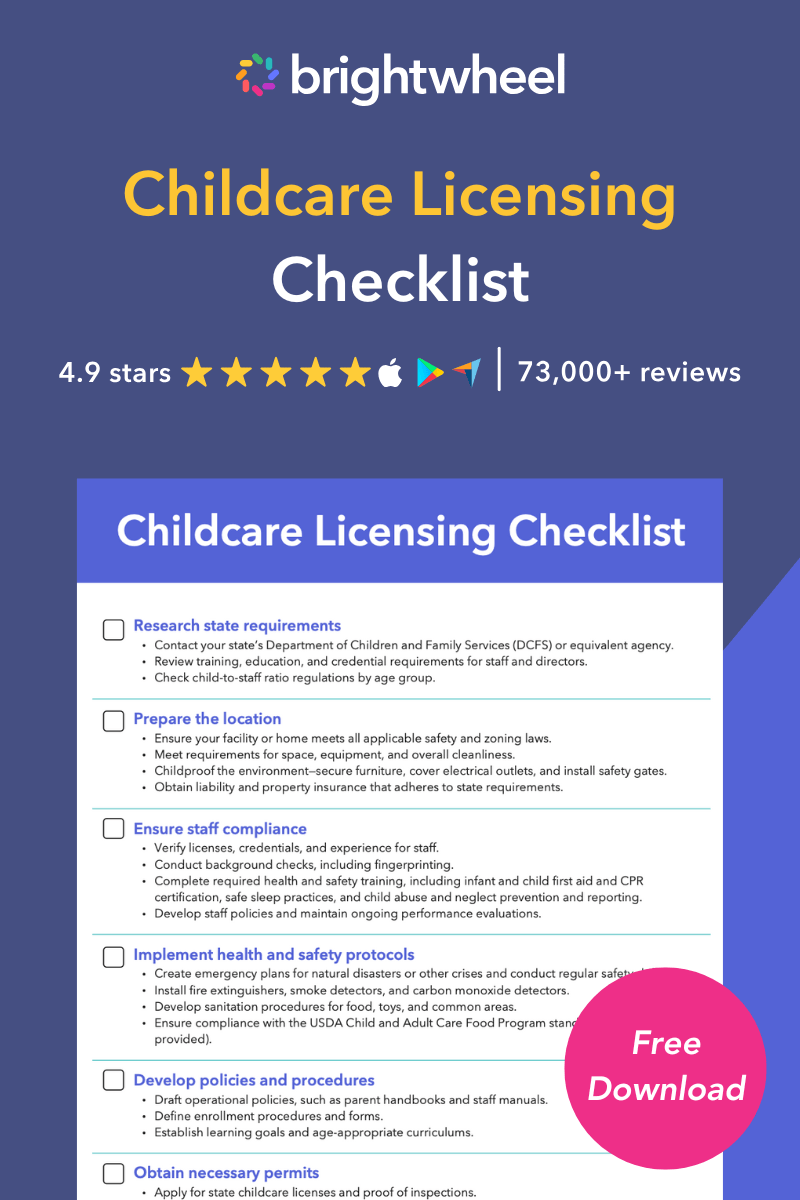
Childcare Licensing and Compliance Checklist
Download this free checklist to simplify the childcare licensing process.
How to start a daycare: Understanding your startup costs
Before diving into the nine steps of launching your daycare, it's essential to get clarity on the financial responsibility ahead. Startup expenses can vary widely depending on your business model, location, and scale.
Typical cost ranges by daycare type
- Home-based daycare: Startup costs typically range from $5,000 to $50,000, reflecting the lower overhead for using your own residence and reducing renovation and facility expenses.
- Small to medium center-based program: Budget between $30,000 and $150,000, depending on facility size, required renovations, and local regulations.
- Larger commercial centers: Startups for centers serving 50+ children may require $250,000 or more due to extensive space modifications, equipment, and licensing requirements.
Cost breakdown by category
| Cost category | Estimated range and notes |
|---|---|
| Facility and renovation | Home-based: minimal; Commercial: leasing + space build-out often range $75K–$300K for larger centers. |
| Licensing and regulatory fees | Typically $500 to $5,000 depending on state and capacity |
| Staff salaries and training | Staff is the largest operating cost; expect full-time salaries between $20,000 to $35,000+ per year, depending on region. Training and background checks can add $100–$300 per employee upfront. |
|
Furniture and supplies (classroom and outdoor) |
One-time setup: $15,000–$50,000. Includes cribs, tables, playgrounds, educational materials. |
| Insurance | Annual premiums range from $1,500 to $5,000, covering general liability, property, and possibly workers’ compensation. |
| Marketing and launch promotions | Allocate $1,000–$7,000 for digital and local outreach, including website setup, printed materials, and open house events. |
| Working capital | Reserve funds covering 3–6 months of operating expenses—$30,000 to $100,000+—are advisable for stability during initial enrollment ramp-up. |
Notes on variability
-
Location matters: Urban areas generally come with higher rent and renovation costs; conversely, rural locations may cost less upfront but could limit tuition potential and scale.
-
Program choice impacts budget: Home-based operations involve fewer regulatory hurdles and facility costs, though they may limit enrollment capacity.
-
Staffing ratios: Required caregiver-to-child ratios (e.g., 1:4 for infants) substantially affect salary outlays—especially critical for infant programs.

How to start a daycare in 9 steps
Opening a daycare requires careful preparation. Follow these steps carefully in accordance with your local and state guidelines to keep your business compliant and help your daycare run smoothly.
1. Learn about daycare licensing requirements
Daycare businesses often start small. You might transition from babysitting and nannying to owning your own childcare business. Making that transition requires you to be compliant with local and state regulations.
To comply with your state's specific rules and regulations, check out Child Care Aware of America’s licensing guidelines for childcare and daycare providers. This resource allows you to research the requirements in your specific state and city.
If the information for your state is unavailable, contact your state’s Department of Children and Family Services (DCFS) or equivalent agency. While the requirements will vary across the country, you typically need to meet specific education and training requirements to obtain a childcare license.
For example, some states require that a childcare center director has a degree in child development or a related field, while others might require a Child Development Associate (CDA) credential or years of experience working with children.
Your local Child Care Resource & Referral Agency (CCR&R) will play a significant role in the information you need. Use them as a resource to understand and remain compliant with all childcare regulations.
2. Write a daycare business plan
Writing a daycare business plan will provide a great advantage and guide you through the rest of the startup process.
To start, decide on a name for your daycare as well as a mission statement. You'll also need to determine your marketing plan, organizational plan, staffing, operations, and budget.
Next, you will need to research the costs of successfully launching a profitable daycare business. Consider the financial aspect of your daycare startup: are you using your own money or seeking a small business loan? Have you looked into daycare grants?
Creating and setting financial goals is crucial to running a successful business. In business, everything costs money, so make realistic expectations and estimates.
For additional help, the U.S. Small Business Association provides detailed instructions on writing a general business plan.
3. Find a location for your daycare
Are you starting an in-home daycare? Are you looking to rent an existing daycare center? Are you planning to start a daycare business from scratch with a new facility?
You’ll often hear the phrase “location, location, location” in real estate. Consider this when searching for your daycare facility location. Note that all families will likely have a preference on where to send their child. Some might choose a quiet suburb over a bustling city. A facility next to a highway might raise safety and security concerns for some families. Remember these factors when searching for a location that fits your business needs.
Additionally, check your city zoning laws and childcare licensing guidelines to ensure your daycare business location is compliant with all regulations.
4. Get insurance for your daycare business
Depending on the type and size of the daycare you're opening, you will need various insurance policies.
Most states require that daycare facilities obtain a license from their state's Department of Health and Human Services (DHHS). Part of the licensing process includes getting liability insurance. Liability insurance protects you and your business if someone gets hurt on your property. It is essential when caring for other people’s children.
Other types of insurance that could be beneficial in running your business include workers’ compensation—if an employee is injured on the job—and commercial property insurance—if your daycare center or assets are damaged and need to be repaired or replaced.
Insurance can get complicated. Find out what coverage is required and check your local childcare provider licensing requirements for guidance.
5. Prepare your daycare facility
What do you need to open a daycare business? You'll need furniture and supplies if you're getting ready to open a daycare center. Use this list to guide you through your preparation.
Safety supplies:- First aid kits
- Smoke detectors
- Carbon monoxide detectors
- Fire extinguishers
- Emergency preparedness kit
- Emergency plan
- Cleaning supplies (all-purpose cleaner, vacuum, rubber gloves, etc.)
- Bathroom supplies (sponges, bucket, mop, etc.)
- Hand sanitizer
- Sanitation plan
- Tables
- Chairs
- Highchairs and/or boosters
- Nap mats and/or cribs
- Step stools
- Shelves and/or storage system
Ages 0-1
- Crib mobiles
- Rattles
- Floor gyms
- Stacking rings
- Nesting cups or boxes
- Large play vehicles
- Dolls and stuffed animals
- Musical instruments
- Puzzles
- Attendance tracking
- Automated billing
- Daily event tracking and recording
- Digital check-in/check-out system
After getting the necessary supplies for your daycare facility, preparing the space also means ensuring it is childproofed. Having safety supplies and measures in place is an irreplaceable step, but you’ll need to take it further. Secure furniture and large appliances to the wall. Install covers on electrical outlets. Avoid keeping small items and toys around the facility to prevent choking.
When opening a daycare, the safety of the children comes first. So spend the time and use the proper resources to set up a safe, compliant daycare center.
6. Develop policies and procedures
Use childcare forms and templates to kick-start developing policies, procedures, and handbooks for your staff and families.
Three important forms are daily report, staff evaluation, and enrollment forms.
- Daily report forms allow the staff to communicate with the parents on their child's progress.
- Staff evaluation forms help you monitor your employees' performance at your center and also provide an opportunity for you to support their professional development.
- Lastly, enrollment forms will typically be one of a parent's first interactions with your business. Carefully craft the messaging to demonstrate a welcoming, inclusive environment for families and their children.
As mentioned in the previous section, preparing your daycare facility also includes needing emergency and sanitation plans. You’ll want to develop a disaster or crisis management plan under the guidance of your local childcare licensing requirements. Your crisis management plan should include health, safety, privacy, and nutrition protocols.
7. Hire staff to help you run your daycare
A daycare center is only as good as its staff, so carefully consider your childcare hiring decisions.
Verify the daycare licensing requirements for staff ratios. The child-to-staff ratio ensures that all children receive adequate care, but depends on factors like the children's age and the daycare center's size. If you plan on running the daycare facility on your own, this will limit the number of children you can have in your facility.
The Childcare Director's Complete Toolkit for Hiring Great Staff
Use this toolkit to interview qualified candidates and hire the best educators for your childcare program.
Additionally, you will need information on the licensing requirements for teachers’ educational backgrounds and other qualifications. Childcare staff may also be subject to criminal background checks and fingerprinting for further investigation. Therefore, verify references and education levels rigorously to avoid faux credentials.
8. Invest in childcare software
One of the best ways to start a successful daycare is to take advantage of the fantastic daycare technologies at your disposal. By streamlining your administrative tasks, you can dedicate more time to delivering a high-quality childcare experience for families.
Getting your childcare license is just the beginning. Launching your program takes planning, tools, and reliable support. That’s why brightwheel offers a dedicated New Program Experience designed to guide you every step of the way. With our all-in-one platform, you can simplify enrollment, set up billing plans, and stay on track for a smooth, successful opening.
 I would say that if you are a new program that you should definitely jump on brightwheel and just experience it. It’s tools that help make your life easier as the owner and director. There’s no reason not to, with the cost and the effectiveness, it’s 100% a yes for me.” Crystal D., Owner & Director at Lil’ Ranch Hands Family Childcare Home in Minco, OK
As I build my new program, the billing features are a game changer. I can easily invoice parents, and everything is automatically tracked—especially helpful come tax season.” Emily K., Owner of Emily Finzen Childcare in Lake Benton, MN
Experience Curriculum allows you to lean into creativity while following the curriculum. It’s all right there, it’s all prepared for you, and then you can lean into it.” Leinani G., Owner of Creative Minds Learning Academy in Bothell, WA
Brightwheel helps us in every way possible. From their onboarding and support team to the features that keep us organized, on track with planning, and communicating smoothly as a team to parents and each other. I couldn't imagine a better management system for our program." Harida H., Administrator at Play Pals Daycare in Maumee, OH
9. Market your daycare business and seek applicants
You'll need a marketing strategy for your childcare center that includes marketing collateral and an online presence.
Here are some ideas to get the word out about your daycare:
- List your business in local childcare directories and participate in your community's daycare or preschool enrollment fairs.
- Advertise through local businesses, parent groups, local events, and popular childcare blogs.
- Try popular early education sites like Tinybeans and Winnie.
- Run a social media campaign focusing on your target population.
- Host a grand opening event to attract families.
Once you’ve managed to fill your inaugural child roster, continue with ongoing marketing efforts so that you’ll always be building a customer base.
FAQs about starting a daycare center
Here are some frequently asked questions about starting a daycare center:
Can you open a daycare center from home?
Most states allow you to operate a daycare center from your home or private residence. Like commercial daycare centers, in-home daycare centers require a license from your state. The National Database of Child Care Licensing Regulations outlines each state's licensing policies and regulations.
How much does it cost to get daycare licensing?
Daycare licensing fees vary from state to state, but they typically cost between $100 and $200. This cost does not include the expenses associated with any additional requirements like obtaining specific education, certification, or training requirements or making sure your facility or home is up to your state's standards.
How long does it take to get licensed?
The average time it takes to receive a daycare license varies by location but can take several months. However, this process can take longer if you lack the proper experience or documentation to fulfill your state’s requirements.
Are daycare centers profitable?
Your daycare center's profitability depends on many aspects of your business including your location, operating costs, tuition rates, and employee compensation. Generally, daycare centers in areas with higher costs of living can typically charge more for tuition.
How much can you charge for child care?
The average cost of center-based daycare in the United States for one child is approximately $13,000 per year. However, the price you charge for child care will depend on numerous factors, including business location, local rates, average state tuition, and the child’s age.
Your rates can also fluctuate based on what kind of child care you provide and whether you offer part-time, full-time, or after school care.
How much does it cost to get insured?
The cost of business insurance varies based on the type of coverage policy. On average, you’ll pay the following premiums for business insurance:
- Business owner’s policy (BOP) = $84/month
- General liability insurance = $53/month
- Business property insurance = $63/month
- Professional liability insurance = $46/month
- Workers’ compensation = $86/month
- Small business health insurance = $623/month, single coverage
What makes a daycare attractive to families?
When choosing a daycare center, families look for high-quality childcare programs that have the below characteristics:
- Small class sizes with low child-to-teacher ratios
- Qualified and well-trained childcare staff with low turnover
- Highly experienced childcare director
- A safe and hygienic learning environment with age-appropriate curriculum
- Adequate learning materials and resources and nutritious foods
- Active family engagement
- Accreditation by relevant education associations
Learn more about daycare licensing regulations in your state
Want guidance on how to start a daycare in your state? Consult your state's childcare licensing department or check out our state-specific guides below for more information:
- Alabama
- Alaska
- Arizona
- Arkansas
- California
- Colorado
- Connecticut
- Delaware
- Florida
- Georgia
- Hawaii
- Idaho
- Illinois
- Indiana
- Iowa
- Kansas
- Kentucky
- Louisiana
- Maine
- Maryland
- Massachusetts
- Michigan
- Minnesota
- Mississippi
- Missouri
- Montana
- Nebraska
- Nevada
- New Hampshire
- New Jersey
- New Mexico
- New York
- North Carolina
- North Dakota
- Ohio
- Oklahoma
- Oregon
- Pennsylvania
- Rhode Island
- South Carolina
- South Dakota
- Tennessee
- Texas
- Utah
- Vermont
- Virginia
- Washington
- Washington, D.C.
- West Virginia
- Wisconsin
- Wyoming
Take the first step to opening a daycare center today
Starting a childcare business is both a rewarding and challenging journey. From navigating licensing requirements and managing startup costs to hiring staff and building trust with families, every step requires thoughtful planning.
By following these steps, you’ll have a clearer understanding of how to start a daycare that not only meets state regulations but also creates a safe, nurturing environment for children. With the right preparation and dedication, your daycare can grow into a thriving business that makes a lasting impact on your community.