.svg)
Imagine a child stacking blocks, noticing patterns, or figuring out how to fit shapes together. These everyday moments are the start of mathematical thinking—skills like problem-solving, logical reasoning, and spatial awareness that go far beyond counting.
Fostering these skills doesn’t require fancy tools or complex lessons. Simple, play-based activities can spark curiosity and build critical reasoning abilities, setting the foundation for lifelong learning. From recognizing patterns to solving small puzzles, these early math experiences benefit everything from language development to social skills.
Why mathematical thinking matters in early childhood
The preschool years represent a critical window for cognitive development. During this time, children's brains form neural connections at an extraordinary rate, making it the ideal period to introduce mathematical concepts through play and exploration.
Mathematical thinking activities strengthen executive function skills, including working memory, cognitive flexibility, and inhibitory control. These skills help children focus attention, follow multi-step directions, and adapt their thinking when faced with new challenges.
Research shows that children who develop strong mathematical reasoning skills early demonstrate better problem-solving abilities across all subject areas. They learn to approach challenges systematically, consider multiple solutions, and persist when faced with difficulties.
Mathematical thinking also enhances spatial reasoning, which connects to success in science, technology, engineering, and mathematics fields. When preschoolers manipulate blocks, complete puzzles, or explore shapes, they build spatial awareness that supports future learning in geometry, physics, and engineering concepts.
These foundational skills extend beyond academics. Children with strong mathematical thinking abilities often display increased confidence, better communication skills, and enhanced creativity in their daily activities.
How to think mathematically
Regular math activities are a great way to help children develop mathematical thinking. But another simple way is to use daily moments to practice it. For example, whenever children need to be put into groups for something, give each child a number between one and ten. Then, once the groups are set, have the children add their assigned numbers together and make the total number the name of their group.
Another strategy for getting children to think mathematically is to model your own problem-solving and involve them in it. A moment for this is when you need to organize something, such as a bookshelf, and figure out how each item can fit. Ask the children how many items to use, where they can go, and what they think when it’s finished.
Since mathematical thinking is about bringing a philosophy into daily life, it’s important to constantly encourage it. So, always be on the lookout for opportunities to discuss math and situations that need to be solved. Involve the children and ask them open-ended questions that will inspire them to think deeper. Here are some examples:
- What do you think about this?
- What do you notice about this?
- Is there another way to fix this?
- How can we figure this out?
- What is the same about these?
- What is different about these?
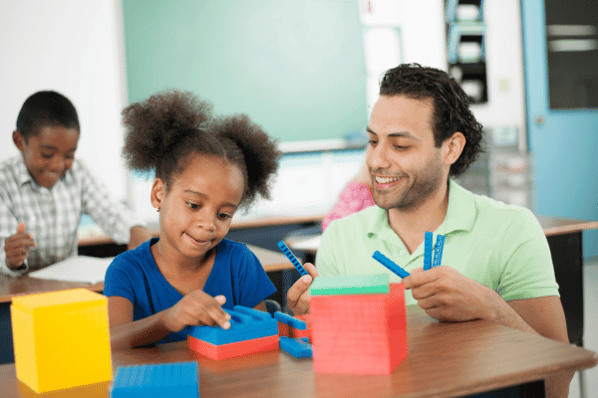
Mathematical mind
In Montessori philosophy, there is a belief that children are born with a “mathematical mind.” This is a natural tendency for things like exploration, order, orientation, and exactness. And over time, that tendency manifests into logical, systematic thinking and the ability to imagine, create, and think abstractly. So, under Montessori’s mathematical mind philosophy, children naturally have a mathematical mind, but it’s important to foster and enrich it throughout their development.
10 simple activities that build problem-solving skills
There are daily moments in the preschool classroom where you can incorporate mathematical thinking. But, to sharpen it as a skill, it’s essential to focus specific activities on it. Use brightwheel’s lesson plan feature to easily incorporate these activities into your schedule. Nearly any activity can be turned into a mathematical thinking moment with some modifications or additional questions, especially STEAM activities. Here are more examples to use in your classroom:
1. Height measurement games
Create measuring opportunities throughout your childcare program by comparing children's heights, measuring plants, or tracking growth over time. Provide various measuring tools like rulers, measuring tapes, or even non-standard units like blocks or paper clips.
Children develop comparison skills as they determine who is taller or shorter, estimate measurements before checking, and record their findings. This activity strengthens number sense, introduces measurement concepts, and encourages mathematical vocabulary like "taller," "shorter," and "equal."
2. Pattern recognition with blocks
Set up pattern stations using colored blocks, shapes, or everyday objects. Start with simple AB patterns (red-blue-red-blue) and gradually introduce more complex sequences. Encourage children to create their own patterns and challenge friends to continue them.
Pattern recognition builds logical thinking and helps children predict what comes next in sequences. This skill transfers to reading, music, and mathematical concepts they'll encounter throughout their education.
3. Sorting and classifying toys
Provide collections of objects for children to sort by various attributes—color, size, shape, texture, or function. Use buttons, shells, toy cars, or classroom materials. Challenge children to find different ways to organize the same collection.
Sorting activities develop classification skills and logical reasoning. Children learn to identify attributes, make decisions based on criteria, and understand that objects can belong to multiple categories simultaneously.
4. Counting with everyday objects
Incorporate counting into daily routines using snacks, toys, or outdoor materials like leaves and rocks. Focus on one-to-one correspondence, where children touch each object while saying its number. Introduce concepts like "more," "less," and "equal."
This activity builds number sense and helps children understand that numbers represent quantities. Regular counting practice strengthens the foundation for more complex mathematical operations.
5. Shape scavenger hunt
Organize indoor or outdoor hunts where children search for circles, squares, triangles, and rectangles in their environment. Provide shape cards as references and encourage children to explain why they think an object matches a particular shape.
Shape recognition develops spatial reasoning and geometric understanding. Children learn to identify attributes, compare similarities and differences, and apply mathematical concepts to real-world objects.
6. Simple puzzles
Offer puzzles with varying difficulty levels, from large-piece floor puzzles to more challenging jigsaw puzzles. Include both picture puzzles and geometric shape puzzles to provide different types of problem-solving experiences.
Puzzle solving strengthens spatial reasoning, visual processing, and persistence.
7. Size ordering activities
Create sequences using objects of graduated sizes—nesting cups, measuring spoons, or collectible items arranged from smallest to largest. Children can practice ordering, comparing, and describing size relationships.
8. Cooking and baking
Include preschoolers in simple cooking activities that involve measuring, mixing, and following sequential steps. Use measuring cups, timers, and recipe cards with pictures to guide the process.
Cooking integrates multiple mathematical concepts including measurement, fractions, time, and following directions. Children experience practical applications of mathematical thinking while developing life skills.
9. Calendar and date awareness
Establish daily calendar routines where children identify the date, count days until special events, and observe patterns in months and seasons. Use visual calendars with numbers, pictures, and weather tracking.
Calendar activities introduce time concepts, number recognition, and pattern awareness. Children develop understanding of sequences, cycles, and mathematical relationships in everyday contexts.
10. Money and coin games
Introduce play money activities through dramatic play scenarios like grocery stores or restaurants. Focus on coin recognition, simple exchanges, and understanding that different coins have different values.
Money games combine multiple mathematical concepts including counting, value recognition, and practical problem-solving.
Signs your preschooler is developing mathematical thinking
Watch for these signs that demonstrate growing mathematical reasoning abilities in young children:
Curiosity about numbers and shapes:- Asking questions about quantities
- Noticing patterns in their environment
- Showing interest in mathematical concepts during play
- Spontaneously counting objects or commenting on shapes they observe
Recognizing patterns and sequences:
- Continuing simple patterns
- Predicting what comes next in familiar routines
- Creating their own repeating sequences with objects or movements
Enjoying problem-solving challenges:
- Persisting with difficult tasks
- Trying multiple approaches when the first attempt doesn’t work
- Feeling satisfied after successfully completing challenging activities
Using mathematical language during play:
- Listening for words like “more,” “less,” “bigger,” “smaller,” “first,” “last,” “before,” and “after” in their conversations and play.
Common challenges and solutions
Many childcare programs face resource limitations when implementing mathematical thinking activities. Focus on using readily available materials like natural objects, recyclable items, and existing toys. Mathematical thinking develops through exploration and questioning, not expensive equipment.
Limited time for activities can feel overwhelming for busy educators. Integrate mathematical thinking into existing routines—count during snack time, discuss shapes during outdoor play, and incorporate patterns into transition activities. These brief moments accumulate into significant learning opportunities.
Engaging reluctant children requires finding their individual interests and connecting mathematical concepts to their preferences. Some children respond to competitive games, others prefer collaborative activities, and many engage through storytelling or dramatic play scenarios.
Staff training may be necessary to help educators recognize and support mathematical thinking opportunities. Provide professional development on identifying mathematical concepts in everyday activities and asking questions that promote deeper thinking.
Building lifelong learners through mathematical thinking
Preschool mathematical thinking activities build strong foundations for academic success and problem-solving. Through play-based experiences, children develop positive associations with mathematical concepts and gain confidence.
Incorporating simple activities can enhance your children's learning and support their cognitive development, extending far beyond just math skills.