.svg)
Expanding your childcare program offers a valuable opportunity to serve more families and build a sustainable business. Successful growth in childcare often stems from careful planning at every stage.
This comprehensive guide outlines the essential steps to strategically and successfully expand your childcare business.
Market research and demand analysis
Before moving forward with expansion plans, conduct thorough market research to validate demand in your target area. Start by analyzing demographic data including birth rates, working parent populations, and household income levels. These metrics directly correlate with childcare demand.
Study your competition by visiting other childcare programs in the area. Note their enrollment capacity, pricing structure, and service offerings. Look for gaps in the market—perhaps there's high demand for infant care or extended hours that competitors aren't meeting.
Survey existing families about their needs and referral potential. Many successful expansions happen because current families move to new neighborhoods or have friends seeking quality child care. Their feedback provides valuable insights into what services to prioritize at your new location.
Financial planning and funding
Developing a detailed financial plan is crucial for expansion success. Calculate startup costs including facility preparation, equipment, licensing fees, and initial marketing expenses. Factor in ongoing operational costs like rent, utilities, insurance, and payroll for the first 12 months.
Create realistic revenue projections based on your target enrollment and local market rates. Remember that new programs typically reach full capacity within 6-12 months, so plan for a gradual revenue ramp-up period.
Explore various funding options to support your expansion:
- Small business loans: Traditional bank loans or SBA loans offer competitive rates for established businesses
- Equipment financing: Specialized loans for playground equipment, classroom furniture, and technology
- Grants: Research local and federal grants specifically available for childcare programs
- Investors: Consider bringing in partners who understand the childcare industry
Location and facility considerations
Choosing the right location significantly impacts your program's success. Look for areas with high concentrations of working families, good visibility, and easy access for drop-off and pick-up. Proximity to schools, residential neighborhoods, and business districts often works well.
Ensure the facility meets all licensing requirements before signing any lease agreements. Requirements vary by state but typically include minimum square footage per child, outdoor play space, and specific safety features like fencing and secure entrances.
Consider the building's condition and any necessary renovations. Factor these costs into your budget, as creating age-appropriate spaces often requires significant investment in flooring, lighting, and child-safe fixtures.
Staffing and training
Recruiting qualified staff remains one of the biggest challenges in childcare expansion. Start your hiring process early, as finding experienced teachers takes time. Develop competitive compensation packages that include benefits to attract quality candidates.
Ensure all staff meet state licensing requirements, which typically include background checks, health clearances, and minimum education or training credentials. Some states require specific childcare coursework or certifications.
Create comprehensive training programs covering your program's policies, curriculum, and emergency procedures. Consistent training across all locations helps maintain quality standards and builds family confidence in your expanded services.
Marketing and enrollment strategies
Develop a targeted marketing strategy to build awareness in your new community. Start marketing efforts 3-6 months before opening to generate interest and pre-enrollment.
Digital marketing tactics prove particularly effective for childcare programs:
- Create location-specific social media pages showcasing your facility and staff
- Optimize your website for local search terms
- Partner with pediatricians, real estate agents, and local businesses for referrals
- Host community events like open houses or family fun days
Streamline your enrollment process with brightwheel and make it easy for families to register. Offer virtual tours and online enrollment forms to accommodate busy families' schedules.
Regulatory compliance and licensing
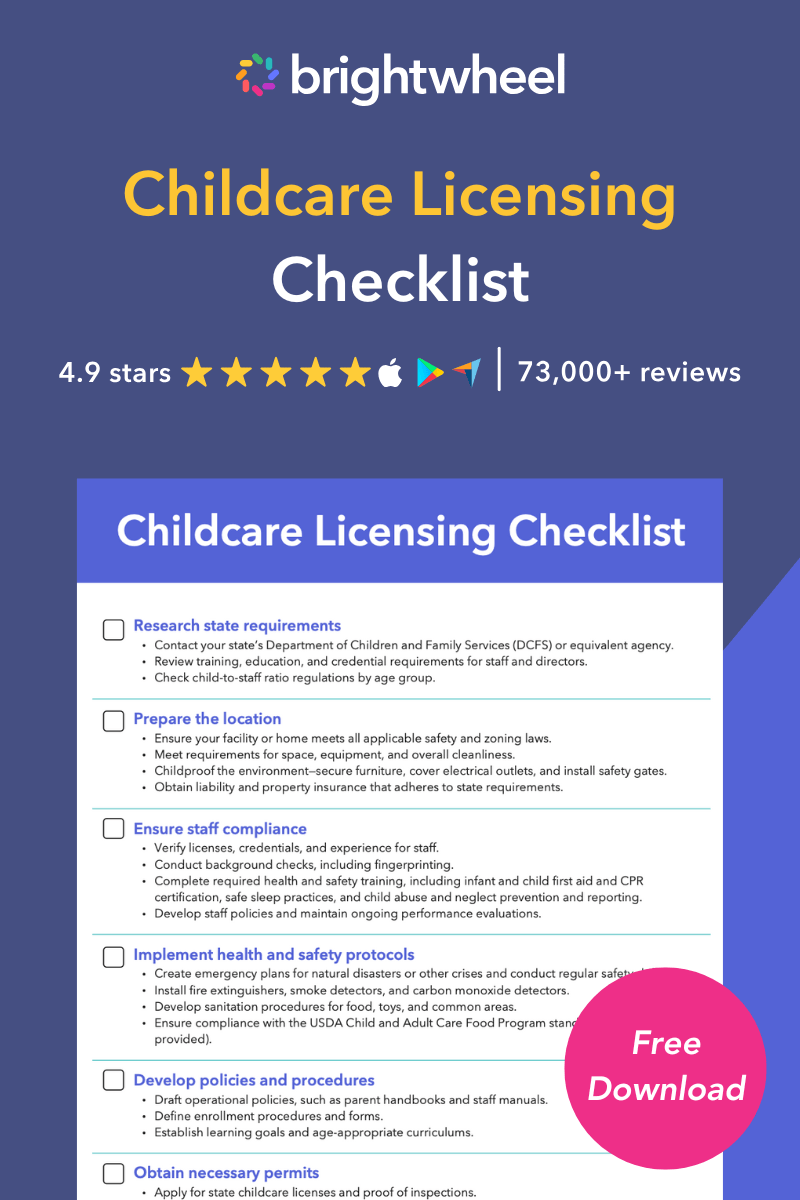
Understanding state and local regulations prevents costly delays and ensures smooth operations. Contact your state's childcare licensing agency early in the planning process to understand specific requirements for your expansion.
Common licensing requirements include:
- Facility inspections for health and safety compliance
- Staff-to-child ratios that vary by age group
- Background checks and training requirements for all staff
- Emergency preparedness plans and procedures
Allow extra time for the licensing process, as inspections and approvals can take several weeks or months depending on your location.

Childcare Licensing and Compliance Checklist
Download this free checklist to simplify the childcare licensing process.
Technology integration
Implementing technology solutions helps streamline operations across multiple locations. Childcare management software like brightwheel offers powerful features designed specifically for large and multi-site centers.
Key technology features for expanding programs include:
- Centralized enrollment management: Track enrollment and waitlists across all locations from one dashboard
- Multi-location billing: Process payments and manage accounts for families across different sites
- Staff scheduling and management: Coordinate staffing needs and maintain proper ratios at each location
- Real-time reporting: Access attendance, enrollment, and financial reports for each location instantly
- Parent communication tools: Send updates and announcements to families regardless of which location they use
- User roles and permissions: Assign customizable roles and permissions to staff members, ensuring that each team member has access to the tools and information they need while maintaining data security and privacy
These integrated systems reduce administrative burden and help maintain consistent service quality across all locations.
 I would say that if you are a new program that you should definitely jump on brightwheel and just experience it. It’s tools that help make your life easier as the owner and director. There’s no reason not to, with the cost and the effectiveness, it’s 100% a yes for me.” Crystal D., Owner & Director at Lil’ Ranch Hands Family Childcare Home in Minco, OK
As I build my new program, the billing features are a game changer. I can easily invoice parents, and everything is automatically tracked—especially helpful come tax season.” Emily K., Owner of Emily Finzen Childcare in Lake Benton, MN
Experience Curriculum allows you to lean into creativity while following the curriculum. It’s all right there, it’s all prepared for you, and then you can lean into it.” Leinani G., Owner of Creative Minds Learning Academy in Bothell, WA
Brightwheel helps us in every way possible. From their onboarding and support team to the features that keep us organized, on track with planning, and communicating smoothly as a team to parents and each other. I couldn't imagine a better management system for our program." Harida H., Administrator at Play Pals Daycare in Maumee, OH
Quality and curriculum enhancement
Maintaining high-quality care and education standards across multiple locations requires systematic approaches. Develop standardized curriculum guidelines and assessment procedures that all locations follow.
Brightwheel's Experience Curriculum is designed to support early childhood development with hands-on, interactive activities and research-backed teaching methods. The curriculum is tailored for infants, toddlers, and preschoolers, making it adaptable for various age groups and needs. By integrating this curriculum, providers can ensure that each child receives a well-rounded learning experience while also streamlining lesson planning for educators and staff.
Invest in ongoing professional development for your teaching staff. Regular training sessions help maintain consistency and introduce new best practices across your expanded program.
Consider implementing recognized quality rating systems or accreditation programs. These credentials build family trust and often qualify your program for higher reimbursement rates from state funding programs.
Family communication and engagement
Strong family relationships become even more important when managing multiple locations. Implement systems that ensure consistent communication regardless of which site families use.
Utilize technology to maintain regular contact through daily reports, photo sharing, and messaging platforms. Many families appreciate real-time updates about their child's day, especially during the transition to a new location.
Create opportunities for families from different locations to connect through special events, field trips, or online communities. This builds a sense of belonging to your larger program network.
Risk management
Expansion introduces new operational risks that require careful planning and mitigation strategies. Conduct thorough risk assessments for each new location, considering factors like natural disasters, security concerns, and staffing challenges.
Ensure adequate insurance coverage across all locations. Work with insurance providers familiar with multi-site childcare operations to address specific liability and property coverage needs.
Develop comprehensive emergency procedures that account for coordination between locations. Staff should understand how to communicate with your central office and other sites during emergencies.
Taking the next step in your expansion journey
Successfully expanding your childcare business requires careful planning, adequate funding, and systematic execution. Focus on maintaining quality standards while implementing efficient operational systems that support growth.
The key to sustainable expansion lies in building strong foundations—from regulatory compliance to staff development to family relationships. Technology solutions designed for multi-site childcare programs, like brightwheel, can significantly streamline this process, allowing you to focus on what matters most: providing exceptional care for children and families.
Consider partnering with experienced childcare management platforms that understand the unique challenges of expansion. The right technology partner can make the difference between a stressful expansion process and a smooth transition to serving more families in your community.