.svg)
Imagine a child hearing “pat” but thinking you said “bat,” or mixing up similar-sounding words like “tea” and “key.” These small mix-ups can be signs of challenges with auditory discrimination—the ability to hear differences between sounds.
This skill plays a crucial role in how children learn to speak, understand language, and eventually read. When children can’t easily tell sounds apart, it can impact their communication, confidence, and learning in the classroom.
In this article, you’ll learn:
-
What auditory discrimination is
-
Why it matters in early childhood development
-
Signs of difficulty and ways to build stronger skills
What is auditory discrimination?
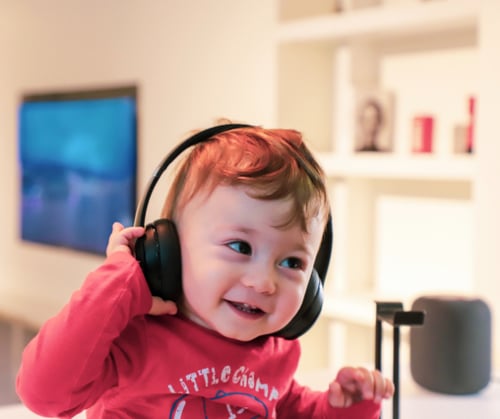
Auditory discrimination is the ability to recognize and distinguish between different sounds. This might include:
-
Telling the difference between similar speech sounds (like /p/ vs /b/)
-
Noticing changes in pitch or tone
-
Recognizing when a word is mispronounced
-
Understanding speech in noisy environments
It’s different from auditory processing (how the brain interprets sounds) and auditory memory (remembering what was heard). Auditory discrimination is the first step—children must hear differences before they can process or use them in speech and reading.
Auditory discrimination is an important pre-literacy skill that improves as children age. Young children need to learn basic auditory discrimination and other sensory development skills, such as visual discrimination, before learning to read.
Why auditory discrimination is important in early childhood
Strong auditory discrimination skills help children:
-
Develop accurate speech sounds
-
Understand spoken directions
-
Build phonemic awareness (key to reading)
-
Learn new vocabulary
-
Communicate clearly with others
In preschool and early elementary settings, children are constantly listening—to teachers, peers, songs, and stories. If they struggle to hear sound differences, they may miss key parts of language learning, mix up words, or have difficulty connecting sounds to letters during reading instruction.
Early support and practice can make a big difference. When caregivers and educators help strengthen auditory discrimination, they’re also building the foundation for literacy, communication, and classroom success.
Signs a child may struggle with auditory discrimination
Children develop auditory discrimination at different paces, but consistent challenges can signal the need for extra support. Here are common signs to look for at home or in the classroom:
-
Mixing up similar-sounding words (e.g., “cat” and “cap” or “dog” and “gog”)
-
Difficulty following verbal directions, especially in group settings
-
Asking “What?” or “Huh?” frequently, even when it’s quiet
-
Trouble identifying rhyming words
-
Mispronouncing words despite repeated exposure
-
Struggling to distinguish between letter sounds during early reading lessons
-
Appearing to “tune out” during conversations or read-alouds
-
Confusion during sound-based games or phonics activities
Not every child showing these behaviors has a delay, but consistent patterns over time may point to auditory discrimination challenges. Catching these signs early makes targeted support and intervention more effective.
Auditory discrimination skills
Auditory discrimination isn’t just one ability—it spans several related skills that help children become confident listeners, speakers, and readers. Here are the key types:
Speech sound (phoneme) discrimination
Recognizing differences between individual speech sounds. This is the foundation of phonemic awareness.
Example: Telling the difference between /p/ and /b/.
Minimal pair recognition
Hearing when two words differ by just one sound.
Example: “coat” vs “goat” or “bat” vs “pat.”
Speech-in-noise discrimination
Understanding speech when there’s background noise.
Example: Listening to a teacher during circle time.
Environmental sound discrimination
Identifying and differentiating nonspeech sounds.
Example: Doorbell vs. microwave beep.
Pitch and frequency awareness
Noticing changes in tone, pitch, and volume.
Example: Recognizing when someone is asking a question vs. telling a story.
Phonological awareness
Phonological awareness includes broader sound skills like syllables, rhyming, and alliteration. Children need auditory discrimination to notice those sound patterns.
Auditory discrimination activities
Activities are a great way to strengthen children's auditory discrimination skills. With brightwheel's lesson plan feature, you can create a custom curriculum of lessons and activities and track children’s progress toward your learning goals.
Try these activities with your preschoolers to strengthen their auditory discrimination skills.
Hearing hike
This outdoor activity helps children learn to listen carefully and identify sounds in nature.
Go outside with your preschoolers, have them close their eyes, and listen to the sounds around them. After a minute, have them name the sounds they hear, such as passing cars, wind rustling in trees, or birds chirping.
Identifying instruments
Using a few different musical instruments, play a few notes to show your preschoolers that each instrument makes a different sound. Then, have them close their eyes as you play one of the instruments. Ask your preschoolers to identify the instrument you played based on its sound.
6f22.jpg)
Animal names
This activity helps children learn to identify the phonemes within words.
For this activity, you'll need pictures of different animals your preschoolers are familiar with. You can use animal flashcards, cut pictures from magazines, or print pictures you find online.
Show your preschoolers a picture of an animal and ask them to say the name of the animal. Then, ask them to say the sound they hear at the beginning of the animal's name. If your preschoolers know how to identify final phonemes, you can also ask them to say the sound they hear at the end of the animal's name.
Rhyming flashcards
This group activity improves children's phonemic awareness by teaching them to create rhyming pairs.
For this activity, you'll need a set of rhyming flashcards. Cut out the flashcards before teaching this activity.
Split your preschoolers into two groups. Give each child in the first group a flashcard. Give each child in the second group a flashcard that rhymes with a card from the first group. Help your preschoolers work together to find the corresponding cards and create rhyming pairs.
Guess who
This activity helps children identify initial phonemes and teaches them that the same phonemes can appear in different words.
Have your preschoolers sit together in a circle. Ask them to guess the name you're going to say, then enunciate and elongate the initial phoneme of the name of one of the children. If the child's name begins with a stop consonant (e.g., /b/, /d/, /p/, /t/, /k/, or /g/), repeat the sound multiple times instead of elongating it (e.g., “/d-d-d-d/ Dylan”). If more than one child's name has the same initial sound, encourage the children to guess multiple names.
Picky puppets
This activity encourages children to think of words that begin with the same initial sound.
For this activity, you'll need an animal puppet.
Introduce the children to the puppet and tell them that the puppet only eats foods that start with the same sound as the type of animal it is. Give the children a few examples of foods that begin with the same initial phoneme as the animal, then encourage the children to think of other foods that the puppet would eat. ("This is Cathy Cat. Cathy only likes to eat foods that start with the /k/ sound. Cathy likes to eat carrots, cake, and corn. Can you think of any other foods that start with /k/ that Cathy would like?")
Connect the sounds
This activity teaches children to blend phonemes to form words.
Choose a short, one-syllable word. Ask the child to put the word's phonemes together to form the word. ("If I put /b/ and /ook/ together, what word do you hear?") If they’re having trouble connecting the phonemes, have them repeat after you as you say the phonemes slowly and gradually speed up the repetition to blend the phonemes together.
How educators can support auditory discrimination skill development
Children make the most progress when the adults around them intentionally support listening and sound awareness. Here are simple ways families and teachers can help:
Create quiet listening moments
Minimize background noise when giving instructions or reading aloud. This helps children focus on speech sounds more clearly.
Use clear speech and repetition
Model correct pronunciation and give children opportunities to repeat tricky sounds or words without pressure.
Incorporate sound play into daily routines
Clap syllables while lining up, match rhyming words during cleanup, or play “guess the sound” while cooking or driving.
Read aloud with intention
Pause to emphasize beginning sounds, rhyming words, and alliteration. Ask questions that prompt children to listen closely.
Encourage active listening
Use prompts like “Did you hear the /s/ sound?” or “What word rhymed with ‘hat’?” to build awareness in real time.
Collaborate with specialists when needed
Speech-language pathologists, educators, and interventionists can recommend targeted strategies if a child shows ongoing challenges.
By creating listening-rich environments and weaving in simple sound activities, educators can make a meaningful impact on a child’s language, literacy, and communication growth.
Build children's pre-literacy skills with auditory discrimination activities
Auditory discrimination may seem like a small piece of early development, but it touches nearly every part of how children learn to speak, listen, and read. When children can hear the difference between sounds, they’re better equipped to build language skills and make sense of the world around them.
With these simple, educational activities that support auditory discrimination skills, you can give children a strong foundation for literacy, learning, and communication.