.svg)
Managing challenging behavior while nurturing emotional growth can feel overwhelming for early childhood educators. Traditional discipline methods often fall short, leaving both teachers and children frustrated. Conscious Discipline® offers a research-based alternative that transforms how we approach classroom management and child development.
So what is conscious discipline, and how can early childhood educators implement it effectively? This evidence-based methodology shifts the focus from punishment to teaching, helping children develop crucial self-regulation skills while creating safer, more connected learning environments.
In this article, we’ll discuss Conscious Discipline®—what it is, how it applies to early childhood education, and how you can learn to implement it.
At a glance: Key takeaways on Conscious Discipline®
What is Conscious Discipline®?
An evidence-based approach to classroom management that focuses on adult self-regulation and teaching children critical social-emotional skills.
Why it matters:
By modeling composure and conscious responses, educators foster positive behaviors, creating a nurturing and productive learning environment.
- Adult self-regulation: Teachers manage their own emotions to guide children effectively.
- Skill-building: Focuses on teaching children conflict resolution, empathy, and other social-emotional skills.
Benefits of Conscious Discipline®:
- Improved classroom relationships
- Reduced disruptive behaviors
- Enhanced emotional resilience for both educators and children
How to get started:
-
- Reflect on your own emotional responses.
- Model calm and composed behaviors.
- Teach children problem-solving and self-regulation strategies.
What is Conscious Discipline® and why does it matter?
Conscious Discipline® is an evidence-based approach that helps educators manage classroom behavior by teaching children emotional regulation through adult modeling. Dr. Becky Bailey, a clinical psychologist and teacher, developed Conscious Discipline® after witnessing years of frustrated educators and struggling children in early childhood settings. Drawing from neuroscience, child development research, and psychology, she created this comprehensive social-emotional learning and classroom management methodology in 1996.
Conscious Discipline® is an adult-first technique that "addresses adult self-regulation and skill sets first to empower adults to model, teach, and live the skills and ideals they want children to acquire." Rather than telling children how to behave, this approach demonstrates healthy ways to manage thoughts, feelings, and behaviors during conflict and difficult situations.
The methodology transforms discipline encounters from punishment opportunities into teaching moments. When educators can maintain composure and respond thoughtfully rather than react impulsively, they create optimal conditions for children to learn essential life skills.
| Aspect | Conscious Discipline | Traditional Discipline |
| Approach | Focuses on teaching self-regulation and building connections. | Emphasizes punishment and control to correct behavior. |
| Goal | Helps children develop emotional intelligence and problem-solving skills. | Aims to enforce rules and maintain order. |
| Focus | Understanding the reasons behind behaviors and addressing them. | Correcting or stopping undesirable behaviors. |
| Methods | Uses empathy, positive reinforcement, and relationship-building. | Often relies on consequences, time-outs, or reprimands. |
| View of Behavior | Sees misbehavior as a learning opportunity. | Views misbehavior as something to be eliminated. |
| Long-term Impact | Encourages self-awareness and internal motivation. | May lead to compliance but can discourage independence or trust. |
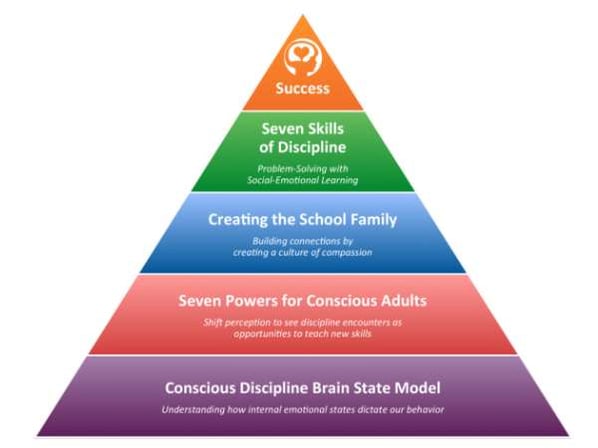
The four components of Conscious Discipline®
Conscious Discipline® builds upon four interconnected components that work together to create lasting behavioral change and emotional growth.
- Brain state model: Understanding how internal emotional states dictate your behavior
- Seven powers for conscious adults: Shifting perception to see discipline encounters as opportunities to teach new skills
- Creating the school family: Building connections by creating a culture of compassion
- Seven skills of discipline: Problem-solving with social-emotional learning
Brain state model
The foundation of Conscious Discipline® lies in understanding how internal emotional states dictate behavior in both children and adults. This brain-body state framework includes three distinct states:
Survival state activates when we perceive threat, triggering the question "Am I safe?" During this state, our options narrow to fight, flight, or surrender responses. For educators, a disrespectful child might trigger this state, leading to reactive responses rather than thoughtful teaching moments.
Emotional state emerges when we feel upset, asking "Am I loved?" In this state, we operate on autopilot, defaulting to patterns learned from authority figures in our own childhood. Educators may find themselves disciplining children exactly as they were disciplined, regardless of effectiveness.
Executive state provides optimal conditions for problem-solving and learning. Here, the brain asks "What can I learn?" This state enables conscious responses rather than automatic reactions, allowing educators to focus on teaching new skills and achieving positive outcomes.
Seven powers for conscious adults
The Conscious Discipline® model states that the biggest threat to a child’s sense of safety is an out-of-control adult. Moving up the pyramid toward successful Conscious Discipline®, the brain state model is followed by the seven powers for conscious adults.
These powers provide a foundation that stops you from reverting to impulsive or reactive behaviors. When you can become conscious, present, and responsive to your needs and the needs of your children, this strengthens your classroom management and discipline system. The key to safety for children in early childhood education settings is a conscious, mindful adult.
The seven powers for conscious adults are:
- Power of perception: Taking responsibility for our upset rather than blaming others.
- Power of unity: Offering compassion to ourselves and others during difficult moments.
- Power of attention: Creating clear images of expected behavior in children's minds.
- Power of free will: Connecting and guiding rather than forcing and coercing.
- Power of acceptance: Responding to what life offers instead of demanding compliance.
- Power of love: Choosing to see the best in others despite challenging behaviors.
- Power of intention: Teaching new skills rather than punishing children for lacking abilities.
Creating the school family
This component shifts classroom management from fear-based external rewards to intrinsic motivation and genuine connection. Built on a healthy family model, the school family emphasizes willingness to learn, self-regulation skills, and focused attention as elements of optimal development for everyone involved—children, educators, and families.
Seven skills of Conscious Discipline®
The final component provides practical tools for responding to challenging situations while modeling positive behaviors:
- Composure: Anger management, delay of gratification
- Encouragement: Pro-social skills, kindness, helpfulness
- Assertiveness: Bully prevention, setting healthy boundaries
- Choices: Impulse control, goal achievement
- Empathy: Emotional regulation, perspective-taking
- Positive intent: Cooperation, problem-solving
- Consequences: Learning from mistakes rather than avoiding them
How you respond to challenging behavior in young children gives you the opportunity to model these skills and teach your children positive social-emotional and communication skills. When you can stay in control and in charge of your children using the skills you want to teach, you are instilling lifelong skills that will last beyond their early childhood education.
How to apply the seven skills of Conscious Discipline®
Implementing these skills requires moving beyond traditional punishment models toward consequence-based learning that empowers children to develop internal motivation and self-reflection.
Replace punishment with learning opportunities
Traditional punishment often causes children to fear making mistakes, rely on adult judgment, or focus primarily on what not to do. Conscious Discipline® transforms these moments into growth opportunities
Consider a child running with scissors—a situation that might trigger many educators' survival state. Instead of yelling "Don't do that!" and scolding the child, Conscious Discipline® suggests a different approach. Help the child understand that mistakes offer learning opportunities, guide them toward self-reflection about safety, and demonstrate proper scissor handling techniques.
Track children's growth in the classroom with brightwheel's daily report feature. Record activities and learning highlights and share with families at the end of each day.
Build meaningful connections
Healthy connections form the cornerstone of effective Conscious Discipline® implementation. Children who feel disconnected from teachers, classmates, or family are more likely to use defensive behaviors to feel safe. Those with positive relationships develop empathy and understand how their actions affect others.
Conscious Discipline® offers the acronym REJECT to help children build connections:
- Rituals for connection
- Encouragement for any success, however small
- Jobs and opportunities to serve others
- Empathy when experiencing upset
- Choices to provide focus during overwhelming situations
- The School Family coaching to help children feel integral to the community
A tool like brightwheel’s communication feature helps improve overall communication and strengthens connections by allowing you to send real-time messages, alerts, and newsletters, all from one central platform.
Foster internal reflection
Effective behavior management comes from within rather than external factors. Help children move beyond focusing on outside influences toward building intrinsic motivation. Guide them to ask "What can I learn?" rather than "Who's to blame?"
When children deflect responsibility—such as saying they pushed someone because that person wouldn't share—they miss opportunities for growth. Help them identify and understand their emotions first, then progress toward regulating those feelings and developing problem-solving skills.
Cultivate responsibility
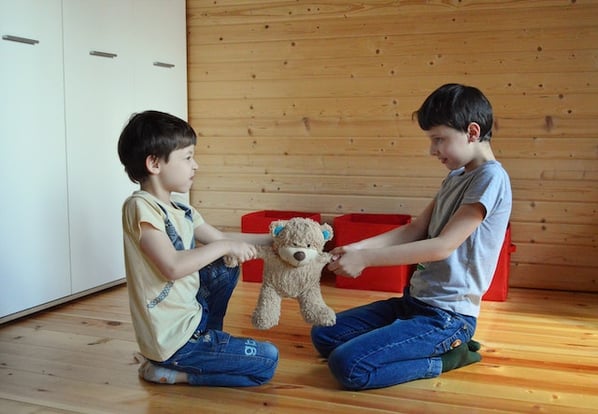
Taking responsibility is a key part of Conscious Discipline® and effective classroom management. Children who avoid accountability for their actions often repeat undesirable behaviors. For instance, a child who grabs a toy from another child because they wanted it may justify their actions by blaming the other child for "not sharing." This deflection prevents growth and increases the chances the behavior will happen again.
To foster responsibility, guide children to first identify and understand their emotions. Then, help them learn to regulate those feelings and develop constructive problem-solving skills. Emphasize that feeling emotions is acceptable, but expressing them appropriately is crucial.
Conscious Discipline® training and implementation
Successfully implementing Conscious Discipline® requires commitment to ongoing learning and practice. The methodology offers several pathways for educators to develop their skills.
- Read the foundational book: Conscious Discipline by Dr. Becky A. Bailey is the starting point for this approach. The book provides skills, strategies, and structures you can use in social-emotional learning and classroom management.
- Take the online course: The “Building Resilient Schools and Homes” 10-session online course guides educators through core methodology, including brain state models, safety protocols, and connection-building techniques.
- Attend the Conscious Discipline® Institute: This traveling seven-day event provides strategies for how educators, as well as social workers, parents, and child advocates, can master Conscious Discipline®.
- Take a two-day workshop: Master and certified instructors host workshops where you can learn various skills related to the practice.
For additional information, Conscious Discipline® offers free and premium memberships that provide general and exclusive access to digital resources.
Create your implementation plan
- Assess your responses: Notice how you currently react to challenging behaviors and practice shifting to a calm, executive state before responding to children.
- Focus on one skill: Don't try to master everything at once. Start with composure—your ability to stay calm during conflicts. This directly impacts your effectiveness.
- Establish routines: Create consistent routines and rituals in your classroom that build safety and connection. Examples include:
- Morning circles
- Conflict resolution procedures
- Celebration practices that reinforce positive behaviors
Frequently asked questions
How long does it take to see results with Conscious Discipline®?
Implementation is a gradual process that varies by individual and classroom dynamics. Many educators notice improved self-regulation within weeks of beginning practice, while lasting behavioral changes in children typically develop over several months of consistent application.
Can Conscious Discipline® work with all age groups?
Yes, the principles adapt effectively across age ranges from infants through elementary school. The specific strategies and language adjust based on developmental stages, but the core concepts of safety, connection, and skill-building remain constant.
What if parents don't understand or support this approach?
Parent education becomes crucial for success. Share the research behind Conscious Discipline® and explain how these skills benefit children beyond the classroom. Provide examples of how the approach builds emotional intelligence, self-regulation, and problem-solving abilities that serve children throughout their lives.
How does this approach handle serious behavioral challenges?
Conscious Discipline® doesn't ignore serious behaviors but addresses them through skill-teaching rather than punishment. For persistent challenges, the approach emphasizes building stronger connections, teaching specific skills the child lacks, and addressing underlying emotional needs that drive problematic behaviors.
Conclusion
Conscious Discipline® is more than a behavior management system; it's a comprehensive approach to nurturing emotional intelligence and self-regulation skills in children by first addressing adult self-regulation.
This evidence-based method fosters authentic teaching and lasting behavioral change, leading to a natural decrease in challenging behaviors as children develop internal motivation and emotional regulation.
To understand what is Conscious Discipline, begin by observing your own responses and practicing the seven powers for conscious adults, modeling the essential life skills you wish to instill in children.