.svg)
When one of your preschoolers throws blocks across the classroom for the third time this week, how do you respond? Traditional timeout methods often fail to address the root cause, leaving both child and teacher frustrated. Restorative practices in the classroom offer a proven alternative that reduces behavioral incidents while building stronger relationships.
Implementing restorative practices in the classroom can transform your approach to behavior management. Instead of just reacting to misbehavior, you can proactively build a strong classroom community where children learn empathy, responsibility, and problem-solving skills.
This article will explain what restorative practices are, their benefits, and how you can introduce them into your early childhood program.
Table of contents:
- What are restorative practices in the classroom?
-
Benefits of restorative practices in early childhood education
- Restorative justice in schools
- Restorative circles
-
Step-by-step guide to implementing restorative practices in the classroom
- FAQ
What are restorative practices in the classroom?
Restorative practices are a framework for building community and responding to conflict by focusing on repairing harm and strengthening relationships. Originating from restorative justice principles, this approach shifts the focus from punishment to understanding and accountability.
In a school setting, it’s not about asking, "What rule was broken?" but rather, "Who was harmed, and what needs to be done to make things right?" This method encourages open communication and helps children understand the impact of their actions on others. It’s a form of positive discipline that equips children with essential social and emotional skills.
Key principles of restorative practices include:
- Relationships: The foundation of a restorative classroom is strong, positive relationships between educators and children, and among the children themselves.
- Respect: Every member of the classroom community is treated with dignity and has a voice.
- Responsibility: Children are guided to take ownership of their actions and understand their consequences.
- Repair: When harm occurs, the focus is on repairing the relationship and finding a solution together.
Benefits of restorative practices in early childhood education
Integrating restorative practices into early childhood education offers significant advantages for children, educators, and the entire classroom environment. This approach goes beyond simple classroom behavior management by fostering a supportive and empathetic community.
The benefits of restorative practices in schools include:
- Improved social-emotional skills: Children learn to identify their feelings, express them constructively, and develop empathy for others.
- Stronger classroom community: By focusing on relationships and mutual respect, these practices help create a sense of belonging and safety for everyone.
- Reduced disruptive behaviors: When children feel heard and understood, they are less likely to act out. Research has shown that schools using these methods see a decrease in suspensions, disciplinary referrals, and disruptive behavior.
- Increased problem-solving abilities: Children become active participants in resolving conflicts, learning valuable negotiation and communication skills.
- Enhanced educator-child relationships: The focus on connection and understanding helps build trust between educators and children, creating a more positive learning atmosphere.
Restorative justice in schools
Restorative justice is a subset of restorative practice. It's responsive in nature and is a formal process where someone who's caused harm to an individual or group can meet with those they've harmed or affected. Compared to restorative practice, which uses various strategies and interventions to be proactive and responsive, restorative justice in schools is a peer-mediated meeting where affected parties can make amends and reintegrate children back into the classroom community.
As a result, schools implementing restorative justice programs can change the school culture and strengthen campus communities, prevent bullying, and reduce conflicts. Over time, schools have seen a reduction in suspensions and expulsions, and children feel happier and safer.
Restorative circles: Building classroom community
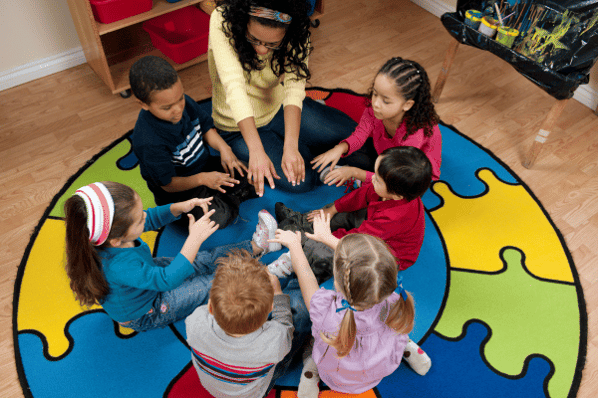
One of the most effective tools for implementing restorative practices is the restorative circle. Circles are structured conversations where everyone sits in a circle, and each person has an equal opportunity to speak and be heard without interruption. This format promotes a sense of equality and encourages honest communication.
There are two main types of restorative circles:
- Proactive circles: These are used to build relationships and foster a sense of community. They can be part of the daily routine, such as a morning meeting, where children share their feelings or answer a fun question. Proactive circles help establish the trust and safety needed for when conflicts arise.
- Responsive circles: These are used to address conflict or harm after it has occurred. In a responsive circle, those involved in the incident discuss what happened, who was affected, and how to repair the harm. This process helps children take responsibility for their actions in a supportive setting.
Step-by-step guide to implementing restorative practices in the classroom
Implementing restorative practices in your classroom can transform your learning environment. This approach fosters a sense of community, builds empathy, and equips students with the skills to resolve conflicts constructively.
By integrating these strategies, you create a supportive space where every child feels valued and responsible. Here’s a practical guide to help you begin this journey in your classroom.
1. Start with proactive circles
Begin by incorporating proactive circles into your daily schedule. This helps children get comfortable with the format and builds a strong foundation of trust.
- Establish a routine: Hold a circle at the same time each day, such as in the morning or after lunch.
- Use a talking piece: Introduce an object that gives the holder the exclusive right to speak. This teaches children to listen respectfully and wait their turn.
- Start with simple prompts: Ask fun, low-stakes questions like, "What is your favorite animal?" or "What did you do this weekend?" to encourage participation.
2. Introduce restorative language
Shift your language to be more restorative. This involves asking questions that encourage reflection rather than placing blame.
- Instead of asking, "Why did you do that?" try, "What happened?"
- Instead of saying, "You're in a time-out," ask, "What were you thinking at the time?" and "Who has been affected by what you have done?"
- Guide children toward solutions by asking, "What do you think you need to do to make things right?"
3. Use circles to resolve conflicts
Once your children are familiar with the circle format, you can use responsive circles to address conflicts.
- Gather those involved: Bring together the children directly involved in the incident.
- Use the talking piece: Ensure everyone gets a chance to share their perspective without interruption.
- Follow a script: Guide the conversation with restorative questions to help children understand the impact of their actions and collaboratively decide on a solution.
- Follow up: Check in with the children later to ensure the agreement is working and the harm has been repaired.
4. Involve families
Share your classroom’s approach with families. When they understand restorative practices, they can reinforce the same principles at home. Send newsletters or hold brief workshops explaining the benefits and how they can use restorative language with their children.
Using a tool like brightwheel's communication feature lets you keep parents updated on their child's progress and communicate what restorative practices they've learned and any conflicts they've resolved.
Measuring success: Results of restorative practices
You can observe the success of restorative practices through changes in your classroom environment. Look for indicators such as:
- A noticeable decrease in challenging behaviors and conflicts.
- Children independently using restorative language to resolve disagreements.
- A stronger sense of community and cooperation among children.
- More positive interactions between children and with educators.
By focusing on connection and repair, restorative practices create a classroom where every child feels valued and supported, setting the stage for lifelong social and emotional well-being.
Frequently asked questions about restorative practices
What is the difference between restorative practices and traditional discipline?
Traditional discipline often focuses on punishment for breaking rules (e.g., time-outs or loss of privileges). Restorative practices, on the other hand, focus on repairing the harm caused by an action and restoring relationships. It's a collaborative process that involves understanding the impact of behavior and finding a solution together.
Are restorative practices appropriate for very young children?
Yes. Restorative practices can be adapted for any age group. For toddlers and preschoolers, it may involve simpler language, more guidance from the educator, and a greater focus on building empathy through stories and role-playing. Proactive circles are especially effective for classroom community building with young learners.
How long does it take to see results?
Implementing restorative practices is a gradual process, not a quick fix. Building a restorative classroom culture takes time and consistency. While you may see small positive changes within a few weeks, significant shifts in classroom dynamics and children's behavior can take several months.