.svg)
Running a successful childcare program involves significant investments in equipment—from playground structures and learning materials to computers and kitchen appliances. What many program administrators don't realize is that these purchases can generate substantial tax savings through depreciation deductions.
Understanding equipment depreciation can save your childcare program thousands of dollars annually while helping you make smarter financial decisions about equipment purchases and replacements.
This article will walk you through everything you need to know about depreciation for childcare programs, including the methods available, step-by-step calculations, and practical strategies to maximize your tax savings.
Quick overview: Key depreciation benefits for childcare programs
Before diving into the details, here are the essential benefits depreciation offers your childcare program:
- Immediate tax relief: Reduce your taxable income through equipment write-offs
- Cash flow improvement: Lower tax bills mean more funds available for program operations
- Strategic planning tool: Plan equipment purchases to optimize tax benefits
- Multiple method options: Choose depreciation approaches that match your program's needs
- Substantial savings potential: Programs can save thousands annually through proper depreciation strategies
What is depreciation and why it matters for your childcare program
Depreciation is an accounting method that allows businesses to deduct the cost of equipment and assets over their useful life. Instead of claiming the entire purchase price as an expense in the year you buy equipment, depreciation spreads that deduction across multiple years.
For childcare programs, this creates several important advantages. First, depreciation provides predictable annual tax deductions that help with financial planning. Second, it allows you to recover the cost of expensive equipment purchases over time, improving cash flow. Third, the IRS recognizes that equipment loses value through wear and use, so depreciation reflects the real-world decline in your assets' worth.
Consider a $15,000 playground structure for your childcare program. Rather than claiming the full $15,000 deduction in year one, depreciation lets you spread this deduction over seven years (the IRS-designated useful life for playground equipment). This approach provides steady tax benefits while matching the equipment's declining value over time.
Depreciation methods for childcare programs
The IRS offers several depreciation methods, each with distinct advantages depending on your program's financial situation and equipment types.
Straight-line depreciation
Straight-line depreciation divides an asset's cost evenly across its useful life, creating identical annual deductions. This method offers simplicity and predictability, making it ideal for childcare programs that prefer consistent tax planning.
Benefits for childcare programs:
- Equal annual deductions simplify budgeting
- Easy calculations require minimal record keeping
- Predictable tax benefits aid financial planning
- Works well for equipment with steady usage patterns
Best suited for: Furniture, HVAC systems, building improvements, and equipment used consistently throughout the year.
Declining balance depreciation
This accelerated method allows larger deductions in early years, with decreasing amounts over time. The most common version is double declining balance, which doubles the straight-line percentage and applies it to the remaining asset value each year.
Benefits for childcare programs:
- Higher initial tax savings improve early cash flow
- Matches equipment's faster value decline in early years
- Particularly valuable for technology purchases
- Provides flexibility for programs with variable income
Best suited for: Computers, tablets, vehicles, and equipment that becomes obsolete quickly.
Sum-of-the-years’ digits depreciation
This accelerated depreciation method allows you to take larger deductions in the earlier years of an asset's life and smaller deductions in later years. It uses a formula based on the asset's useful life to create a depreciation schedule that gradually decreases over time.
Benefits for childcare programs:
- Accelerates tax deductions to offset upfront costs
- Reflects the quicker loss of value for certain assets
- Simplifies planning for equipment replacement
- Useful for items that lose value or obsolesce rapidly
Best suited for: Technology like tablets or computers, classroom furniture, or new playground equipment that undergoes heavy use in the first few years.
Units of production depreciation
This method bases depreciation on actual equipment usage rather than time. You depreciate based on hours used, miles driven, or units produced relative to the equipment's expected lifetime capacity.
Benefits for childcare programs:
- Matches depreciation to actual wear and tear
- Provides larger deductions during heavy-use periods
- Offers precise cost tracking for specialized equipment
- Helpful for seasonal or variable-use equipment
Best suited for: Vehicles used for field trips, specialized therapy equipment, or seasonal outdoor equipment.
Section 179 deduction
Section 179 lets you deduct the full cost of equipment purchases right away, up to $1,250,000 for tax year 2025. It’s a great way to skip complicated depreciation rules for qualifying purchases.
Benefits for childcare programs:
- Immediate full deduction in the purchase year
- Significant cash flow improvement
- Simplified record keeping with no depreciation schedules
- Particularly valuable for smaller programs with lower purchase volumes
Best suited for: Most childcare equipment purchases, especially for programs buying less than $100,000 annually in equipment.
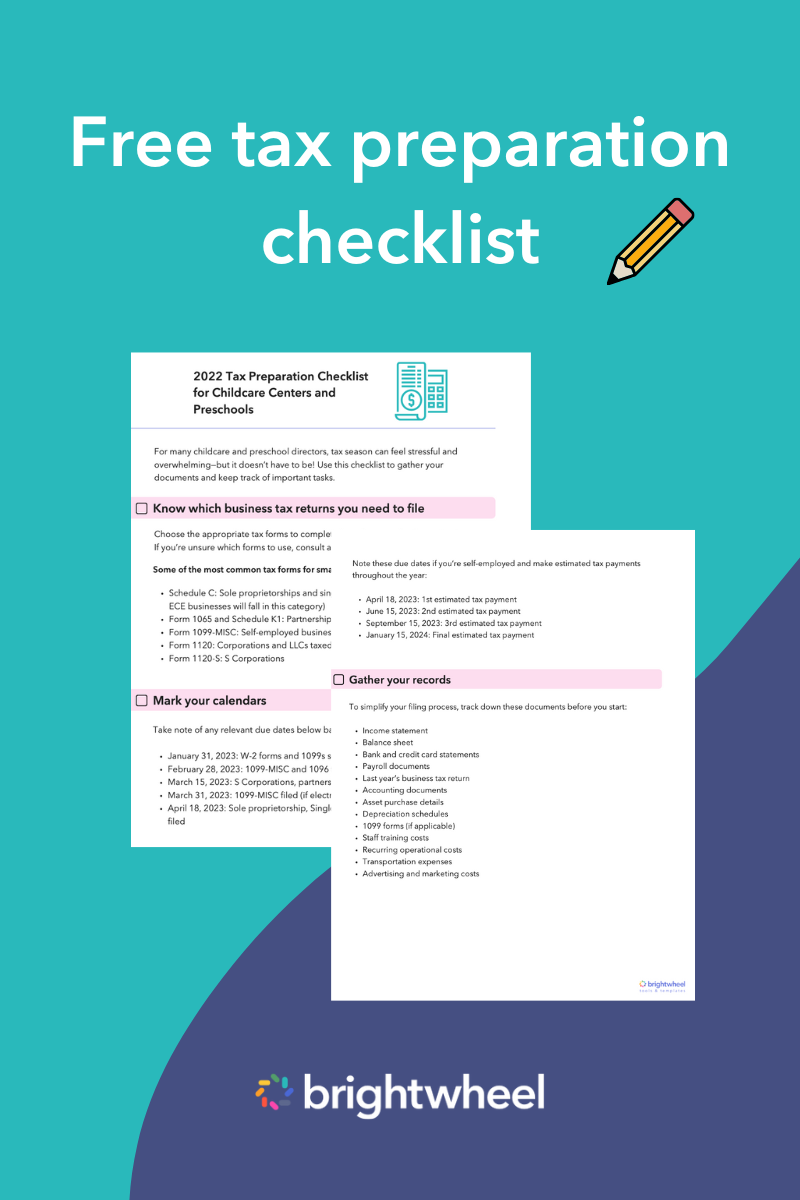
Whether you are new to doing your business taxes as a childcare provider or you are a long-time business owner, using tools and software is always helpful. With brightwheel’s billing tool you’ll have access to the perfect features to make billing, tracking, and reporting efficient and to make tax season as smooth as possible.

Tax-Saving Strategies for Childcare Programs
A free tax guide for increasing deductions and minimizing tax liabilities.
Which depreciation method works best for childcare programs
Most childcare programs benefit most from combining Section 179 deductions with straight-line depreciation. Here's why this combination works well:
- Use Section 179 for: Equipment purchases under $50,000 annually, computers, playground equipment, kitchen appliances, and furniture. This provides immediate tax relief and simplifies bookkeeping.
- Use straight-line depreciation for: Large equipment purchases that exceed Section 179 limits, building improvements, and situations where you prefer steady annual deductions for planning purposes.
- Consider accelerated methods when: Your program has strong current income but expects lower future income, or when purchasing technology that becomes obsolete quickly.
Step-by-step guide to calculating depreciation
Let's walk through several depreciation calculations using a practical childcare program example.
Example: Your program purchases $25,000 in playground equipment with a seven-year useful life.
Straight-line calculation:- Asset cost: $25,000
- Useful life: 7 years
- Annual depreciation: $25,000 ÷ 7 = $3,571 per year
Double declining balance calculation:
- Straight-line percentage: 100% ÷ 7 years = 14.29%
- Double declining rate: 14.29% × 2 = 28.58%
- Year 1 depreciation: $25,000 × 28.58% = $7,145
- Year 2 depreciation: ($25,000 - $7,145) × 28.58% = $5,104
- Continue until asset is fully depreciated
Section 179 calculation:
- Simply deduct the full $25,000 in the year of purchase, provided your total Section 179 deductions don't exceed annual limits.
Tips for maximizing depreciation deductions
Smart depreciation planning can significantly increase your tax savings. Here are proven strategies used by successful childcare programs:
- Time major purchases strategically. If your program has a particularly profitable year, consider accelerating equipment purchases to maximize current-year deductions through Section 179.
- Maintain detailed records. Document purchase dates, costs, and business use percentages for all equipment. This documentation is essential for claiming depreciation and protecting deductions during audits.
- Consider bonus depreciation opportunities. First-year bonus depreciation allows additional deductions for new equipment, often 100% of the cost for qualifying purchases.
- Bundle smaller purchases. Rather than buying equipment piecemeal, consider bundling purchases to take advantage of Section 179 limits more effectively.
- Plan for mixed-use items. Equipment used partially for personal purposes requires allocation between business and personal use. Only the business portion qualifies for depreciation.
Common depreciation mistakes to avoid
Many childcare programs miss out on significant tax savings by making these common errors:
- Forgetting to start depreciation. Depreciation begins when equipment is placed in service, not when it's purchased. Starting depreciation late means losing valuable deductions.
- Mixing up useful lives. Different equipment types have specific IRS-designated useful lives. Using incorrect timeframes can trigger audits and reduce allowable deductions.
- Overlooking improvements versus repairs. Equipment improvements must be capitalized and depreciated, while repairs can be immediately expensed. Understanding this distinction affects your deduction timing.
- Claiming personal-use equipment. Only equipment used for your childcare program qualifies for business depreciation. Mixed-use items require careful allocation between business and personal portions.
- Poor record keeping. Inadequate documentation can result in lost deductions during IRS examinations. Maintain detailed records for all depreciated assets.
Maximize your childcare program's tax savings
Equipment depreciation represents one of the most valuable tax strategies available to childcare programs. By understanding the different methods available and implementing proper planning, your program can save thousands of dollars annually while maintaining better cash flow for serving the families in your community.
Consider consulting with a tax professional who understands childcare program operations to ensure you're maximizing these valuable deductions. Your program's financial health—and the families you serve—will benefit from these tax savings for years to come.
This article is designed to provide general information regarding the subject matter covered. It is not intended to serve as legal, tax, or other financial advice related to individual situations. Because each individual's legal, tax, and financial situation differs, specific advice should be tailored to the particular circumstances. For this reason, you are advised to consult with your own attorney, CPA, and/or other advisors regarding your specific situation.