.svg)
AI in education is transforming the way we teach and learn, bringing exciting possibilities to classrooms everywhere. In early childhood education, these advancements are opening new doors for personalized learning experiences and enhanced teaching tools.
Curious about how AI can make a difference in your classroom? Let’s explore the tangible benefits it offers for both educators and young learners.
Understanding AI in education
Artificial intelligence first emerged in the 1940s, but it wasn't until the 1980s that it started gaining widespread popularity. According to the Oxford Dictionary, artificial intelligence is "the theory and development of computer systems able to perform tasks that normally require human intelligence, such as visual perception, speech recognition, decision-making, and translation between languages."
Simply put, AI makes human-like choices to make our lives easier, better, and more streamlined. You're probably already using AI in education tools without realizing it.
Common examples of AI you might recognize include:
- Smart assistants like Amazon Alexa and Siri
- Vehicles with adaptive cruise control and automatic emergency braking
- Automated financial services through companies like Betterment
- Robot-assisted instruction tools designed for children with special needs
In educational settings, AI in education systems can process information, recognize patterns, and make decisions that typically require human intelligence. This technology helps educators by automating routine tasks and providing insights that improve learning outcomes.
How AI enhances early education classrooms
According to Global Market Insights Inc., artificial intelligence in education could reach a value of $30 billion by 2032, up from four billion in 2022. This dramatic growth shows that AI in education isn't just a passing trend—it's becoming an essential part of how we approach teaching and learning.
AI in education can supplement quality instruction and reduce administrative burdens for teachers. Here are key ways childcare programs currently use AI:
-
Administrative efficiency: Streamlining administrative tasks like data collection and report generation gives teachers more time to develop impactful lessons and focus on direct instruction.
-
Assistive technology support: AI makes education more accessible for children with diverse academic, physical, and emotional needs by providing customized accommodations and support tools.
-
Interactive learning games: Children engage with educational games that teach basic academic skills while tracking important data to inform future instruction decisions.
-
Language accessibility: Translation tools help children who speak different languages communicate more effectively, breaking down language barriers in diverse classrooms.
A tool like brightwheel’s communication app allows you to centralize family communication in one platform. You can send real-time messages, emergency alerts, and newsletters, saving you time and improving family relationships.
AI in education: Personalized learning benefits
One of the most significant advantages of using AI in education is its ability to enable personalized learning. Every child learns differently—some grasp concepts quickly while others need more time and support. Some children learn better through visual methods, while others need hands-on activities to understand new concepts.
AI helps level the playing field by making personalized learning more achievable for busy educators.
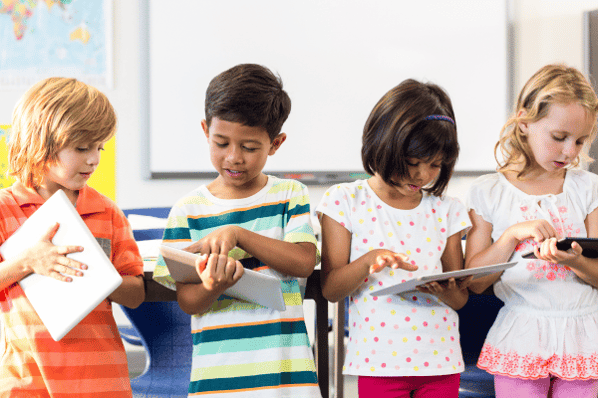
Consider this practical example: Children enter your classroom and play what seems like a simple educational game. While they think it's just fun, the AI system tracks their understanding of essential reading and math concepts. You can use this data as a starting point for instruction planning, allowing you to work on other important tasks while children engage with the technology.
After children complete these activities, you'll have valuable insights into their skill levels across different areas. This information helps you quickly adjust your instruction to meet each child where they are academically.
The more you understand about your children's learning needs, the better you can shape lessons to fit those needs. While AI in education can never replace dedicated teachers, it enhances instruction by helping you serve your children more effectively.

Activities Across Developmental Domains
Use this free guide to craft strategies for activities that foster child development across developmental domains.
Pros and cons of AI in education
While there are various arguments for using AI in an early education setting, there are also concerns about how it’ll impact the education system. As with anything, there are benefits and drawbacks to consider when implementing a new activity, program, or system into our toolbox.
Here are some of the most common pros and cons of AI in education.
Pros of AI in education
- Personalized support: AI programs identify areas where children need extra practice and guide them through activities.
- Adjusts to learning pace: AI ensures all children learn at their own speed, reducing disengagement.
- Reduces teacher workload: AI can decrease administrative burdens, helping retain quality educators.
- Supports diverse learners: AI accommodations can help level the playing field for children with unique needs.
Cons of AI in education
- Cost considerations: High-quality AI programs can be expensive, posing a challenge for programs with limited budgets.
- Potential for bias: AI programs may include unintended biases, particularly racial bias, requiring careful consideration.
- Privacy concerns: Some AI tools lack sufficient privacy protections, especially important with young children.
- Learning curve requirements: Teachers need training to interpret AI-generated data and question inaccuracies.
Preparing for the future of AI in education
AI in education represents a significant technological advance that has the power to change how childcare programs operate. The potential benefits for early childhood classrooms are exciting, and continued development will likely bring even more innovative solutions.
As AI in education continues to evolve, it holds the promise of creating more inclusive, personalized, and effective learning environments for all children. The key is approaching this technology thoughtfully, ensuring it enhances rather than replaces the human connections that make early childhood education so valuable.
For childcare providers ready to explore how technology can streamline operations and enhance learning, tools that integrate AI features alongside comprehensive management systems offer the best of both worlds. These solutions can help you spend less time on administrative tasks and more time focusing on what matters most—nurturing young learners.