.svg)
Creating lesson plans for a group of infants might seem overwhelming at first. Each child develops at their own pace, and their abilities can change rapidly from week to week. But here's the key insight: infant lesson plans aren't about teaching a rigid curriculum—they're about supporting developmental milestones through everyday routines and play.
Understanding developmental milestones for each age group will guide your activity choices and help you monitor each child's progress. This milestone-focused approach ensures you're providing age-appropriate learning opportunities while recognizing that each infant in your care may be at different developmental stages.
What you'll learn in this article:
- Key principles for effective infant lesson planning
- How developmental milestones guide activity selection
- Age-specific lesson plan ideas for 4, 6, 9, and 12-month-olds
- Free downloadable lesson plan templates
- Practical activities you can implement today
Table of contents
- Guiding principles for infant lesson planning
- 4 best practices for infant lesson plans
- Lesson plan ideas for 4-month-olds
- Lesson plan ideas for 6-month-olds
- Lesson plan ideas for 9-month-olds
- Lesson plan ideas for 12-month-olds
- Infant lesson plan templates
Guiding principles for infant lesson planning
Infant lesson plans differ significantly from those designed for older children. Instead of focusing on curriculum delivery, successful infant lesson planning centers on two core principles:
Milestone-driven approach: Rather than teaching specific concepts, your plans should support the developmental milestones infants typically reach at different ages. These milestones span four key areas:
- Social-emotional development: Building relationships and understanding emotions
- Physical development: Gaining motor skills and coordination
- Language development: Learning to communicate and understand words
- Cognitive development: Exploring, problem-solving, and understanding the world
For ideas on how to design developmentally appropriate plans for slightly older age groups, check out this helpful guide on preschool lesson plans.
Responsive and flexible planning: Infant lesson plans must adapt to daily routines and spontaneous learning opportunities. Instead of rigid schedules, focus on creating meaningful learning moments during feeding, diaper changes, and playtime.
If you're planning for toddlers and need more inspiration, explore this resource on lesson plans for toddlers to expand your approach.
-10ddf.png)
4 best practices for infant lesson plans
Creating effective infant lesson plans requires a thoughtful approach that prioritizes nurturing, flexibility, and developmental milestones.
Encourage cross-functional learning
Developmental milestones may be organized into separate categories, but infant learning doesn't happen in isolated blocks. A single activity often supports multiple developmental areas simultaneously.
When you place colorful blocks within an infant's reach, one child might focus on developing the motor skills needed to grasp the block, while another practices sitting independently, and a third explores cause-and-effect by dropping the block repeatedly. This natural cross-functional learning means every activity serves multiple purposes.
Practice responsive planning
Effective infant lesson plans remain flexible enough to capitalize on unexpected learning moments. Rather than creating minute-by-minute schedules, identify ways to weave developmental activities into daily routines.
During feeding time, you might work on fine motor skills by encouraging self-feeding. During diaper changes, you can practice social-emotional development through face-to-face interaction and gentle conversation. This responsive approach ensures learning happens throughout the day, not just during designated activity periods.
Build in activity repetition
Infants benefit tremendously from repetition. When you notice a child enjoying a particular activity—like peek-a-boo or banging two toys together—repeat it frequently. This repetition isn't just about enjoyment; it's essential for skill development and memory formation.
Plan for multiple opportunities to practice the same skills through different activities. If you're working on reaching and grasping, offer various safe objects throughout the week rather than limiting practice to a single toy or timeframe.
Monitor developmental progress
Your lesson plans should include built-in opportunities to observe and assess each infant's progress toward age-appropriate milestones. This doesn't require formal testing—simple observation during activities provides valuable insight into each child's development.
Keep notes on how each infant responds to different activities and which milestones they're approaching or have achieved. This information helps you adjust future plans and provides specific details when communicating with families about their child's progress.
Use a digital platform like brightwheel’s Experience Curriculum to streamline your lesson planning process. This complete curriculum system provides robust tracking capabilities, ready-to-use lesson plan templates, and a variety of activity ideas and materials. With these tools, you can efficiently monitor developmental milestones and simplify planning—making it easier to create engaging, developmentally appropriate lessons for infants without added complexity or time strain.

Lesson plan ideas for 4-month-olds
At four months, infants are developing foundational skills that will support more complex abilities later. Their focus is on building basic motor control, beginning social interaction, and exploring their immediate environment.
Key developmental milestones:
- Social-emotional: Smiling spontaneously, chuckling at playful interactions, seeking attention through movement and sounds
- Physical: Holding head steady, grasping toys placed in their hands, swinging arms at objects, pushing up on forearms during tummy time
- Language: Making cooing sounds, responding to voices with sounds, turning toward familiar voices
- Cognitive: Opening mouth when seeing food, studying their own hands with interest
Activities to support these milestones
- Create conversation opportunities: Respond to every sound an infant makes as if you're having a real conversation. When they coo, coo back. When they babble, pause and wait for their "response." This back-and-forth interaction builds the foundation for future communication skills.
- Provide reaching and grasping practice: Place safe, colorful toys just within reach during tummy time or while infants are lying on their backs. Use toys of different textures and sizes to encourage exploration through touch and mouth.
- Incorporate daily reading time: Look at high-contrast picture books together, pointing to images and describing what you see. Even though infants can't understand the words, they're absorbing language patterns and developing visual tracking skills.
- Maximize interaction time: Limit time in swings, bouncy seats, or strollers. Instead, create safe floor spaces where infants can move freely and interact with their environment and caregivers.

Daily Lesson Plan Template
Use this template to develop effective lesson plans for infants, toddlers, and preschoolers.
Lesson plan ideas for 6-month-olds
Six-month-olds are developing a stronger sense of security and beginning to show more distinct preferences and reactions to their environment.
Key developmental milestones:
- Social-emotional: Recognizing familiar faces, studying themselves in mirrors, laughing in response to stimulation
- Physical: Rolling from tummy to back, supporting weight on straight arms, sitting with arm support
- Language: Taking turns in "conversation," making raspberry sounds, producing squealing noises
- Cognitive: Exploring objects by mouthing them, reaching for desired toys, closing lips to refuse food
Activities to support these milestones
- Daily picture exploration: Use colorful magazines, board books, or photo albums to point out and name different objects, animals, and people. Respond enthusiastically to any sounds or reactions the infant makes.
- Environmental awareness activities: Point out and name everyday objects throughout the day—cars outside the window, birds in trees, toys on shelves. This constant narration builds vocabulary even before infants can speak.
- Encourage rolling and reaching: Place appealing toys just out of reach to motivate rolling, stretching, and reaching. This builds gross motor skills while developing problem-solving abilities.
- Sound exploration: Introduce various sounds through whispering, clapping, singing, or making silly noises. Vary your voice tone and volume to keep infants engaged and support auditory development.
Lesson plan ideas for 9-month-olds
Nine-month-olds show increased mobility and more sophisticated social awareness. They're beginning to understand cause-and-effect relationships and can participate in simple interactive games.
Key developmental milestones:
- Social-emotional: Displaying various facial expressions, responding to their name, reacting to separation
- Physical: Sitting independently, transferring objects between hands, using fingers to manipulate small items
- Language: Repeating syllable combinations like "mamama" or "bababa," raising arms to signal they want to be picked up
- Cognitive: Looking for dropped objects, banging objects together to create sounds
Activities to support these milestones
- Mobility challenges: Place interesting toys slightly out of reach to encourage crawling, scooting, or rolling. Create safe obstacle courses using pillows or soft blocks to navigate around.
- Simple sign language: Teach basic signs for common needs like "more," "all done," or "up." Use these consistently during appropriate activities so infants can begin communicating before they have spoken words.
- Container play: Provide safe containers and blocks for dumping and filling activities. This develops fine motor skills while teaching early math concepts about capacity and quantity.
- Hide-and-seek games: Hide toys under blankets or behind your back, then reveal them with enthusiasm. This teaches object permanence—the understanding that things continue to exist even when they can't be seen.
- Positive instruction practice: Instead of saying "don't stand," try "time to sit." This helps infants learn to follow simple directions while understanding expected behaviors.
Lesson plan ideas for 12-month-olds
One-year-olds are becoming more mobile and communicative. They can participate in interactive games and are beginning to understand and respond to simple verbal instructions.
Key developmental milestones:
- Social-emotional: Engaging in simple games with caregivers
- Physical: Pulling to standing position, cruising along furniture, picking up small objects with finger and thumb
- Language: Waving goodbye, using "mama" and "dada" meaningfully, understanding and responding to "no"
- Cognitive: Placing objects in containers, searching for hidden items
Activities to support these milestones
- Build on emerging language: When infants attempt words, expand on their efforts. If they say "ba" while pointing to a ball, respond with "Yes! That's a ball. It's a red ball." This validates their communication attempts while modeling correct pronunciation and expanded vocabulary.
- Interactive reading: Choose board books with textures, flaps, or simple interactive elements. At this age, "reading" means talking about pictures and letting infants explore the book physically.
- Fine and gross motor challenges: Provide blocks, empty boxes to push around, and toys that encourage standing and cruising. Create safe spaces for exploration while maintaining necessary boundaries for safety.
- Responsive communication: Answer pointing and gesturing with words. When an infant points to their cup, say "You want your cup? Here's your blue cup" rather than simply handing it over. This builds the connection between gestures, objects, and words.
Infant lesson plan templates
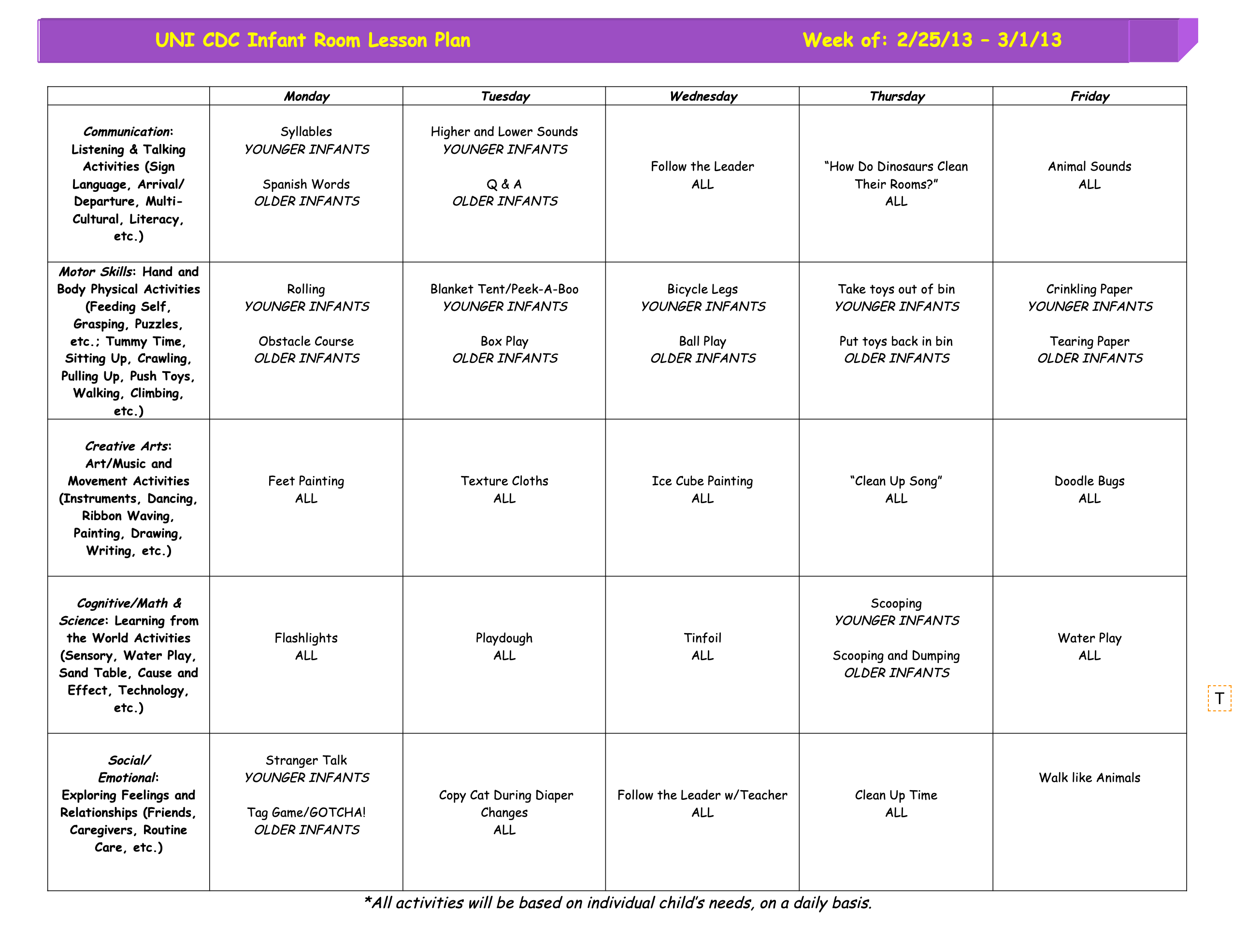
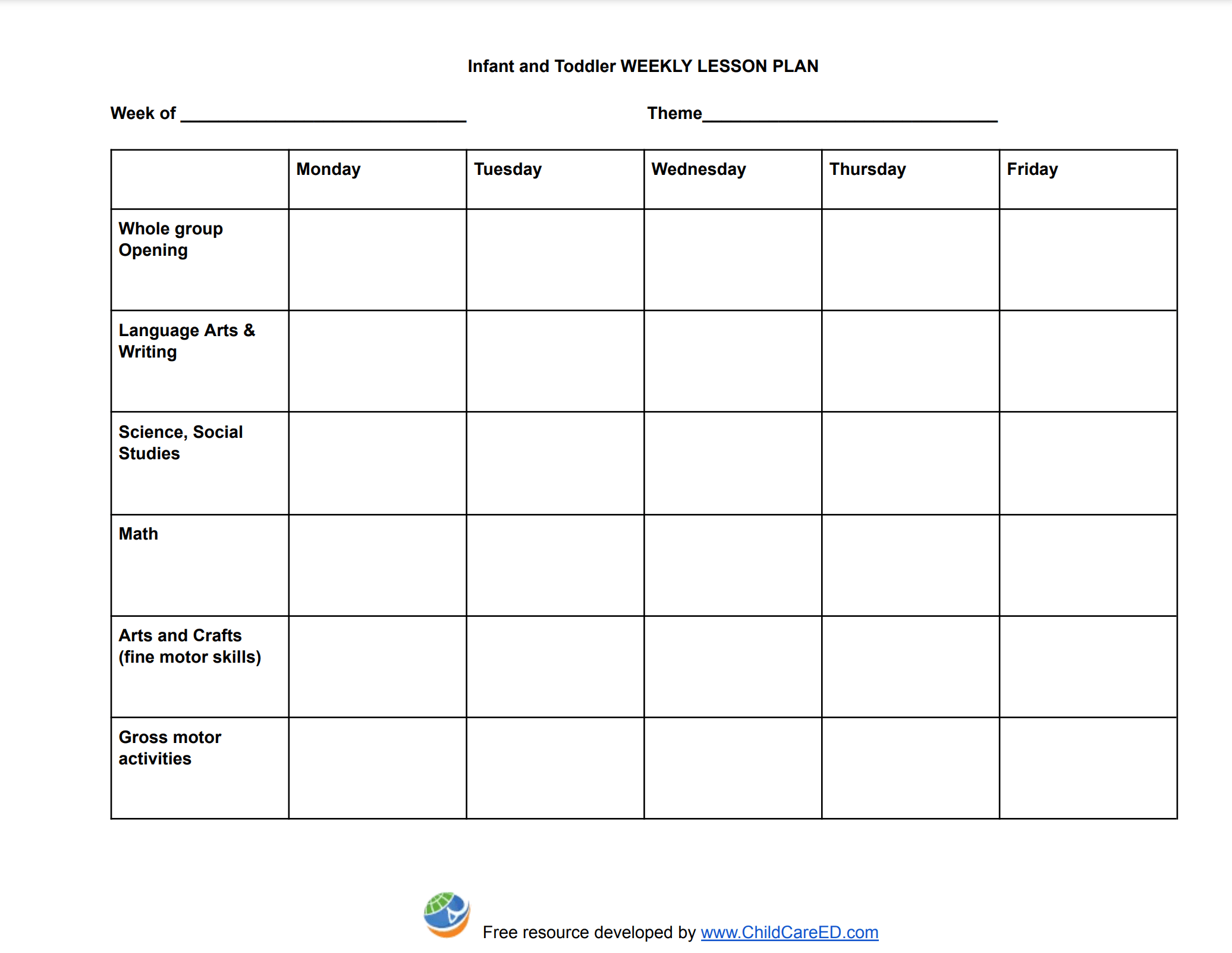
Structured templates help organize your planning while ensuring you address all developmental areas. Here are two downloadable options:
Frequently asked questions
How detailed should infant lesson plans be?
Infant lesson plans should provide enough structure to ensure comprehensive developmental support without being so rigid that they can't adapt to daily realities. Focus on identifying learning objectives and key activities rather than minute-by-minute schedules.
What if infants in my group are at very different developmental stages?
This is completely normal and expected. Choose activities that can be adapted for different ability levels. A single activity—like exploring textured balls—can support reaching skills for some infants while developing more advanced manipulation skills for others.
How do I know if my lesson plans are working?
Look for engaged, happy infants who are making progress toward age-appropriate milestones. Keep simple notes about which activities generate the most interest and participation. Regular developmental observations will show whether children are progressing as expected.
Should I follow the same lesson plan every week?
While some consistency helps infants feel secure, plans should evolve based on the children's changing needs and interests. Repeat popular activities while gradually introducing new challenges as infants master current skills.
Bottom line
Creating effective infant lesson plans requires understanding that every interaction is a learning opportunity. By focusing on developmental milestones and remaining responsive to each child's individual needs, you create an environment where infants can thrive.